Turo Sales Tax: What Turo Collects, What Hosts Still Owe, and How to Check Your State
How sales and rental taxes work on Turo trips: what Turo collects and remits as a marketplace facilitator, the rental-car surcharges and local taxes that vary by state, the taxes hosts still owe (income, personal property, registration), and a state-by-state checklist for verifying your own obligations.
FleetPilot·5 min read·Updated Aug 19, 2026·Reviewed Aug 19, 2026
Key takeaways
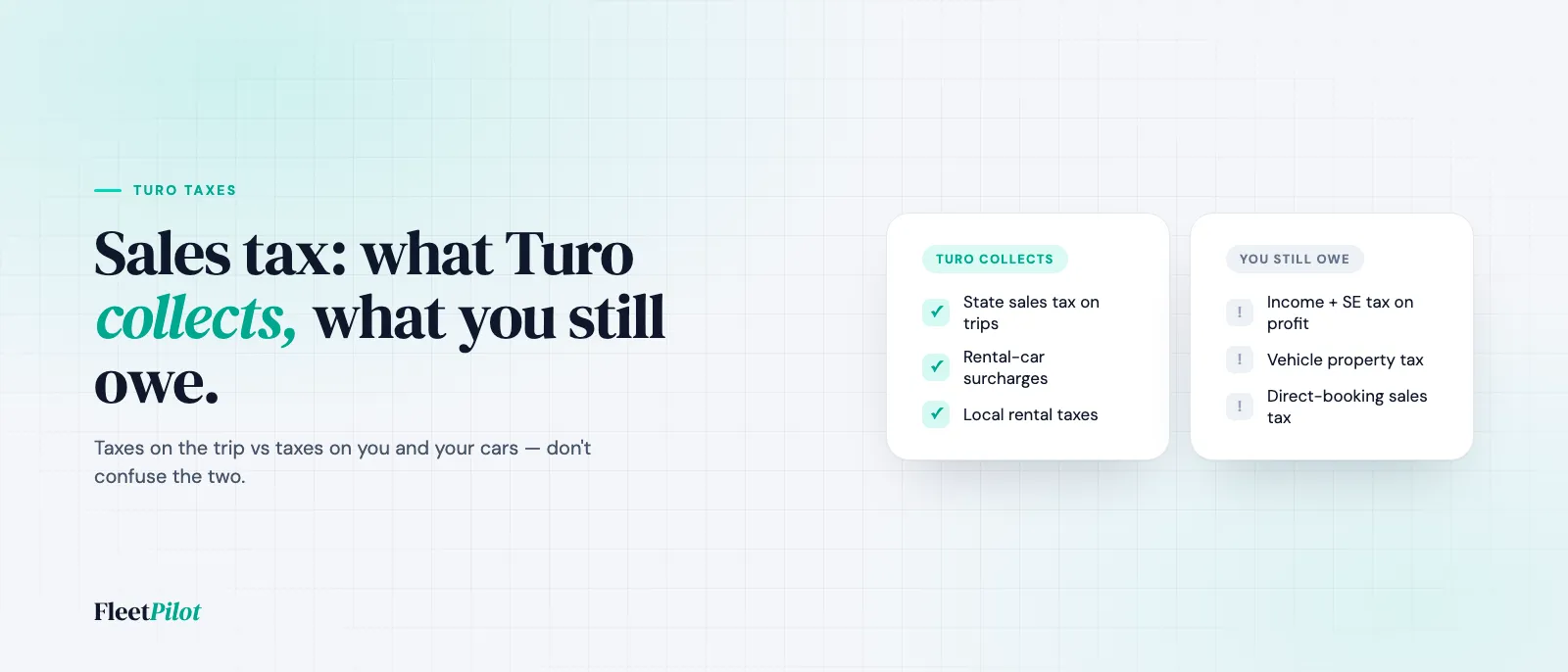
In most US states Turo acts as a marketplace facilitator: it calculates, collects from the guest, and remits state and local sales or rental taxes on trips, so hosts generally do not collect trip sales tax.
'Most' is not 'all' — coverage, rates, rental-car surcharges and city-level taxes vary by jurisdiction and change; verify your own state and city each year rather than assuming.
Sales tax Turo collects is not your income; reconcile from Turo's trip-level earnings export, which separates trip price, Turo's share, reimbursements and taxes.
Hosts still owe income and self-employment tax on profit, plus vehicle personal-property tax, registration and excise taxes, and any local business or rental taxes a facilitator law doesn't cover.
Direct bookings taken outside Turo make you the seller: registering for, collecting, and remitting rental taxes on those trips is on you.
Sales tax on Turo is one of those topics where two hosts in the same Facebook group will confidently tell you opposite things — and both will be right for their state.
Here’s the structure that makes it make sense: there are taxes on the trip, which Turo mostly handles, and taxes on you and your cars, which Turo never handles. Confusing the two is how hosts either double-count or under-pay.
Taxes on the trip: what Turo collects
Since the wave of marketplace facilitator laws that followed the 2018 Wayfair decision, most states require the platform — not the individual seller — to collect and remit sales tax on transactions it facilitates. Turo is a marketplace facilitator.
In practice, on a trip in a state where Turo collects:
Turo calculates the applicable state and local sales tax (and, where they exist, rental-car surcharges or excise taxes) on the trip price.
The guest pays it as a separate line item on their receipt.
Turo remits it to the state. It never passes through your account and it is not part of your earnings.
Turo’s help center maintains the list of jurisdictions where it collects and the taxes it applies. Read it for your state, and re-read it each January — coverage has expanded steadily and rates and surcharges change.
The layers that vary by state
Even where Turo collects, what is collected varies, and it’s worth understanding the pieces so a guest’s receipt or a state notice doesn’t surprise you:
State sales tax on short-term vehicle rentals — some states tax rentals at the general rate, some at a special rental rate, a few not at all.
Rental-car surcharges — many states add a per-day fee or a percentage surcharge to fund transportation, stadiums, or tourism. Texas, for example, imposes a 10% motor vehicle rental tax on rentals of 30 days or less; Florida adds a $2-per-day rental car surcharge. Rates and structures differ widely.
Local taxes — city and county sales taxes, and in some places city-specific rental taxes, layered on top.
Airport or tourism district fees in certain locations.
Because it’s a per-jurisdiction patchwork, don’t rely on a summary table (including anything here) as your source of truth. Use it as a checklist of what to look up.
Taxes on you and your cars: what Turo does not collect
None of these are on the guest’s receipt, and all of them are yours:
State income tax on that profit, in states that have one, plus state estimated payments.
Vehicle personal property tax — states like Virginia, and various counties elsewhere, assess an annual property tax on vehicles based on value. Fleet vehicles are not exempt.
Registration, title, and excise taxes — annual registration and, in some states, an excise or use tax on the vehicle’s value. Some jurisdictions register rental vehicles differently or require a rental designation.
Business licenses and local business taxes — city business licenses, gross-receipts taxes (Los Angeles, San Francisco, and others), and state franchise or LLC fees.
Sales tax on your own purchases — parts, supplies, and equipment. Not recoverable in most states just because you’re a business.
All of these are deductible business expenses on Schedule C where they relate to fleet vehicles — which is another reason to track them per VIN.
The direct-booking exception
The moment you take a booking outside Turo — a repeat guest, a corporate rental, a listing on your own site — you are the seller. In a state that taxes vehicle rentals, you’re responsible for:
Registering for a sales tax permit (and any rental-surcharge registration).
Collecting the correct state, local and surcharge amounts from the guest.
Filing and remitting on the state’s schedule — monthly or quarterly.
Track direct-booking revenue and the tax you collected as separate lines. Commingling it with Turo payouts is how hosts end up either paying income tax on collected sales tax or forgetting to remit it.
Getting the accounting right
Three rules keep sales tax from corrupting your books:
Reconcile from Turo’s trip-level earnings export, not from guest receipts. The export separates trip price, Turo’s share, reimbursements, and tax; the receipt shows the guest’s total including tax that isn’t yours. (See importing Turo earnings.)
Never book collected tax as revenue. For direct bookings, tax collected is a liability until remitted, not income.
Book the taxes you do owe to the vehicle they relate to. Property tax, registration, and excise per VIN. That’s what makes per-vehicle profit honest.
A ten-minute state checklist
Do this once a year, or whenever you add a state:
Search Turo’s help center for taxes on trips. Confirm your state is listed and note which taxes Turo collects there.
Search your state revenue department for “motor vehicle rental tax” or “rental car surcharge.” Note any tax not on Turo’s list.
Check your city/county for a local rental tax or business license requirement.
Confirm whether your state levies personal property tax on vehicles, and how it treats vehicles used commercially.
If you take direct bookings, confirm your sales tax registration is active and filings are current.
Note the state’s estimated income tax due dates alongside the federal ones.
Where the numbers should live
The taxes on the trip vanish before they reach you; the taxes on your cars land as bills spread across the year. Both are easy to lose track of in a spreadsheet.
FleetPilot imports Turo trips with trip price, Turo’s share, reimbursements and taxes as separate lines — so collected tax never inflates revenue — and matches property tax, registration and excise payments from your bank feed to the vehicle they belong to, so every VIN’s true cost includes them. Start on the Free plan — no credit card required.
Frequently asked questions
Does Turo charge sales tax?
+
In most US states, yes — Turo calculates, collects from the guest, and remits state and local sales or rental taxes on trips as a marketplace facilitator, and it appears as a separate line on the guest's receipt. Hosts generally do not collect trip sales tax themselves. Coverage and treatment vary by state and locality, so confirm your own jurisdiction in Turo's help center and your state revenue department.
Do Turo hosts have to pay sales tax?
+
Hosts usually do not remit sales tax on trips where Turo collects it. Hosts do owe income tax and self-employment tax on profit, and may owe vehicle personal property tax, registration and excise taxes, and any local rental or business taxes that a marketplace facilitator law does not cover. Direct bookings taken outside Turo are the host's responsibility entirely.
Is the sales tax Turo collects part of my income?
+
No. Tax collected from the guest and remitted by Turo is not your revenue and should not be in your gross receipts. Reconcile from Turo's trip-level earnings export, which separates trip price, Turo's share, reimbursements and taxes, rather than from a guest-side receipt total.
What if I take direct bookings outside Turo?
+
Then you are the seller and, in states that tax vehicle rentals, you are responsible for registering, collecting, and remitting sales or rental tax and any surcharges yourself. Track direct-booking revenue separately so it is easy to report.
Turo uses "co-host" to mean two completely different things, and conflating them costs owners and operators real money. Here's how the programs differ, what each split actually pays, and what you need in place to run this as a business.
The 1099-K reports gross bookings, not what Turo paid you. Here's who gets one, why the number looks too high, and how to reconcile it so you don't pay tax on Turo's cut.
5 min read·Updated Aug 19, 2026
Co-host statements that are automated and accurate.
FleetPilot turns your Turo, direct rental, and vehicle expense data into a seamless end-of-month owner payout process.