Turo 1099-K Explained: What It Reports, Who Gets One, and What to Do With It
What a Turo 1099-K actually reports, the 2025–2026 federal and state thresholds, why the number is bigger than what hit your bank, and how to reconcile it to your Schedule C without overpaying.
FleetPilot·5 min read·Updated Aug 19, 2026·Reviewed Aug 19, 2026
Key takeaways
Turo issues a 1099-K when your gross payments exceed the federal threshold ($20,000 and 200 transactions for tax year 2025 onward) or a lower state threshold; you owe tax on Turo income whether or not you receive a form.
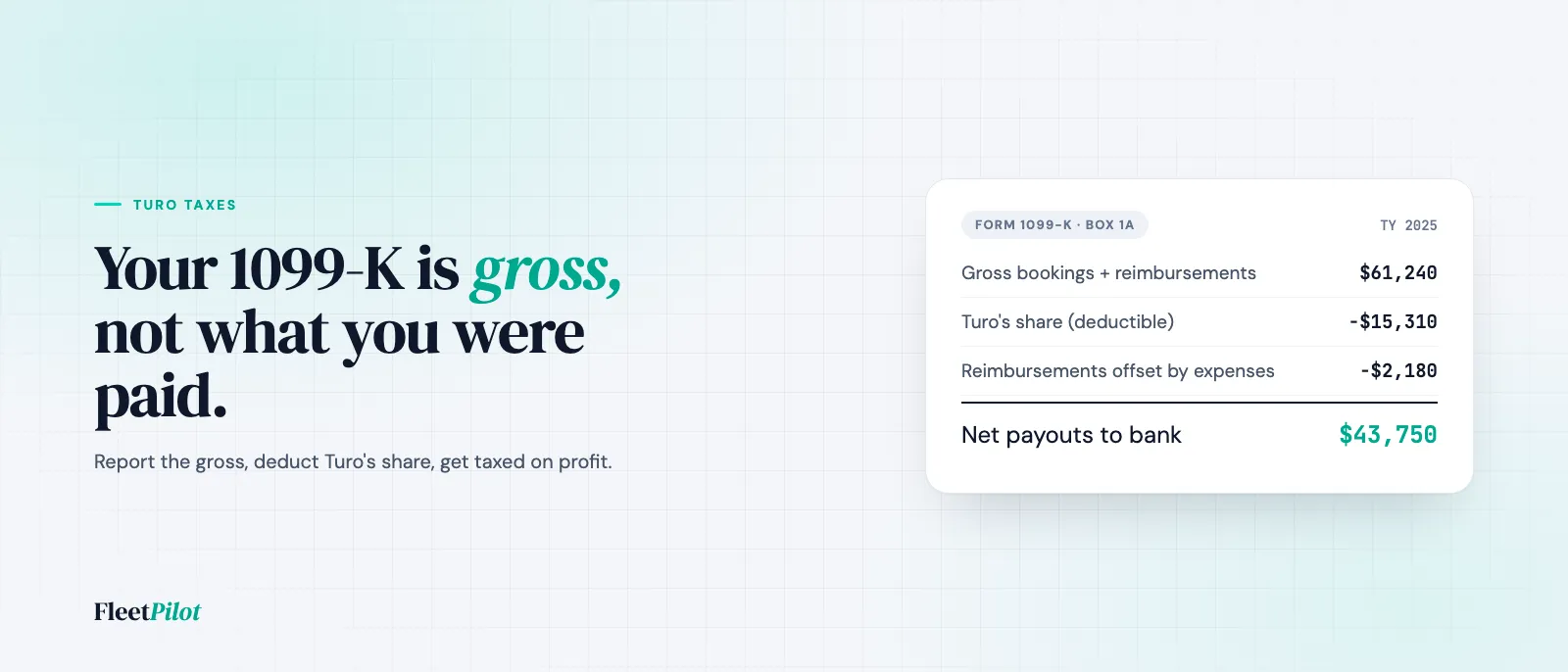
The 1099-K reports gross bookings before Turo's commission and fees, so it will always be higher than your payouts; the difference is a deductible business expense, not phantom income.
Report the 1099-K gross on Schedule C line 1, then deduct Turo's fees, and every other cost of running the fleet, so you are taxed on profit — not on money Turo kept.
Reconcile the form to trip-level records before filing: gross trip price by trip, minus Turo's share, should tie to your payouts within rounding and any adjustments or chargebacks.
If your books are built from payouts alone you will under-report gross and over-report profit, or vice versa; import trips at the gross level and let the fees be their own line.
Every January a wave of Turo hosts open their 1099-K, see a number roughly 25–40% larger than anything that ever hit their bank account, and assume Turo made a mistake.
Turo didn’t. The form is doing exactly what it’s designed to do — and understanding what it reports is the difference between paying tax on your profit and paying tax on Turo’s commission.
What a Turo 1099-K actually is
Form 1099-K is an information return filed by payment settlement entities — card processors and third-party networks — reporting the gross dollar volume of payments they processed for you. Turo, as the marketplace that collects guest payments and pays hosts, is the reporting party.
Three things follow from “gross”:
It’s the guest’s side of the transaction, not yours. The 1099-K reports what guests paid, before Turo’s commission, protection plan fees, and adjustments came out.
It includes things you passed straight through. Reimbursements guests paid for fuel, tolls, mileage overage and cleaning show up in gross volume, even though you spent the money.
It’s not a bill. The IRS gets a copy, so they know roughly how much moved through your account. What you owe is determined by your Schedule C, where you subtract expenses.
Who gets one: the thresholds
The federal threshold changed several times in the last few years and is now settled:
Tax year 2025 onward: Turo files a 1099-K if your gross payments exceed $20,000 AND you had more than 200 transactions. The $600 threshold enacted in 2021 — and the IRS’s $5,000 / $2,500 phase-in toward it — was repealed retroactively by the 2025 federal tax law (OBBBA); the IRS confirmed the $20,000/200 rule applies for 2025 and 2026 filings.
State thresholds can be lower. Several states (Maryland, Massachusetts, Vermont, Virginia, Illinois, New Jersey and DC among them) require 1099-K reporting at much lower amounts — as low as $600 with no transaction minimum. If you host in one of those states, expect a form even with a small fleet.
If you’re under every threshold, Turo doesn’t send a form. The income is still taxable. The threshold governs Turo’s filing obligation, not yours.
Turo makes the form available in the host dashboard, generally by January 31, and mails a copy if you elected paper delivery.
Why the number is bigger than your payouts
Take a single trip:
Line
Amount
Trip price paid by guest
$420.00
Guest fuel reimbursement
$38.00
Gross (what the 1099-K reports)
$458.00
Turo’s share at a 25% plan
−$105.00
Net payout to you
$353.00
Multiply by a season and the gap is thousands of dollars. Nothing is wrong. Turo’s $105 is a deductible business expense — commissions and fees — and the $38 fuel reimbursement is offset by the fuel you bought.
The mistake is treating the 1099-K number as income and your payouts as… also income, or (worse) reporting only payouts and then getting a CP2000 notice when the IRS’s matching program sees a Schedule C gross lower than the 1099-K it holds.
Where it goes on your return
For almost every host, Turo income is business income reported on Schedule C (see Do You Need an LLC for Turo? for the Schedule C vs Schedule E question).
Line 1 (Gross receipts): report the 1099-K gross — plus any Turo income not on the form (direct bookings you took outside Turo, cash reimbursements).
Commissions and fees: Turo’s share, protection plan costs, and any other platform fees.
Everything else: depreciation, insurance, maintenance, cleaning, tolls, parking, supplies, software — see the Turo tax deductions checklist.
The IRS specifically expects to see the 1099-K amount reflected in gross receipts. If your gross is lower than the form, you’ll want an explanation ready — and “I only booked payouts” is not a good one.
How to reconcile before you file
The form is right until proven wrong, so prove it either way:
Export trip-level earnings from Turo for the tax year — trip price, reimbursements, Turo’s share, and net, by trip. (The earnings import guide covers the export.)
Sum gross trip price + reimbursements. That should tie to the 1099-K box 1a within rounding — Turo appears to report by settlement date rather than trip end date, so a trip that ended December 30 but settled January 2 may fall into the following year.
Sum Turo’s share. That’s your commissions-and-fees deduction.
Sum net payouts and tie to your bank. Every payout should match a deposit.
If all three tie, the form is right and your books are right. If step 2 is off by a lot, look for a second Turo account, a co-host arrangement where the vehicle owner (not you) is the payee, or trips settled across the year boundary.
The co-hosting wrinkle
If you operate cars for owners, the 1099-K goes to whoever Turo pays — usually the host account, meaning you. You then pay owners their split.
That means the entire gross lands on your 1099-K, and the owner’s share is your expense (payments to owners), documented by owner statements. Depending on how much you pay each owner and how they’re structured, you may in turn owe them a 1099-MISC or 1099-NEC — the threshold is $2,000 for payments made in 2026 ($600 for 2025 payments). This is one of the strongest reasons to keep statements and payouts reconciled every month rather than reconstructing them in March.
Common mistakes
Reporting only payouts. Under-reports gross; the IRS’s matching flags it.
Reporting the 1099-K gross and forgetting to deduct Turo’s fees. Over-pays tax on money you never received — the single most expensive 1099-K mistake.
Booking reimbursements as income and forgetting the matching expense. Fuel, tolls, and cleaning reimbursements should net to roughly zero.
Ignoring the year-boundary. Settlement date, not trip date, decides which year’s form a trip lands on.
Not keeping the form. Keep the 1099-K, the trip export, and the reconciliation with your tax records for at least three years.
What this looks like when it’s automated
The reconciliation above is arithmetic — but it’s arithmetic across hundreds of trips, two revenue sides, and a year boundary, which is why most hosts end up doing it once a year, in March, from memory.
FleetPilot imports Turo trips at the gross level, records Turo’s share and each reimbursement as its own line, and ties every payout to the bank deposit as it lands. At year end the 1099-K reconciliation is a report, not a project — and the same ledger produces Schedule C mappings and per-vehicle depreciation your CPA can file from. Start on the Free plan — no credit card required.
Turo issues Form 1099-K to US hosts whose payments cross the reporting threshold — federally, more than $20,000 in gross payments and more than 200 transactions for tax year 2025 onward, and lower amounts in several states. Turo makes the form available in the host dashboard, typically by January 31.
Why is my Turo 1099-K higher than what I was paid?
+
The 1099-K reports gross transaction volume — what guests paid — before Turo's commission, protection plan fees, and adjustments are subtracted. Turo's share is your business expense; you deduct it on Schedule C so you are taxed only on what you actually kept.
Do I have to report Turo income if I didn't get a 1099-K?
+
Yes. The 1099-K threshold determines whether Turo files a form with the IRS, not whether the income is taxable. All Turo income is reportable regardless of whether a form was issued.
What if the 1099-K amount is wrong?
+
First reconcile it against your own trip-level records — most 'wrong' forms are the gross-versus-net gap. If it is genuinely wrong (a duplicate account, someone else's vehicles), contact Turo support for a corrected form. Do not file with a number you cannot tie to records.
Turo uses "co-host" to mean two completely different things, and conflating them costs owners and operators real money. Here's how the programs differ, what each split actually pays, and what you need in place to run this as a business.
Depreciation is the biggest deduction on a Turo return and the most misunderstood. Here's how MACRS, bonus, Section 179 and the luxury-auto caps interact — with a worked example — and why per-vehicle records decide whether you can actually claim it.
12 min read·Updated Aug 19, 2026
Co-host statements that are automated and accurate.
FleetPilot turns your Turo, direct rental, and vehicle expense data into a seamless end-of-month owner payout process.