Turo Taxes: Standard Mileage vs Actual Expenses (Why Almost Every Host Uses Actual)
Whether Turo hosts can use the standard mileage rate, why the actual expense method is the default for rental vehicles, the five-car fleet rule, and how to switch methods without losing depreciation.
FleetPilot·4 min read·Updated Aug 19, 2026·Reviewed Aug 19, 2026
Key takeaways
The standard mileage rate (70¢ per mile for 2025; 72.5¢ for the first half of 2026 and 76¢ from July 1, 2026) is designed for taxpayers driving their own vehicle for business; Turo vehicles are driven by guests, so the rate is a poor fit and often unavailable.
If you use five or more vehicles at the same time in the business, the IRS bars the standard mileage rate outright — the actual expense method is your only option.
Under the actual expense method you deduct depreciation plus every real operating cost, times the vehicle's business-use percentage; for a dedicated Turo car that is 100%.
Choosing accelerated depreciation (MACRS, bonus, Section 179) in year one locks that vehicle into the actual method — you cannot later go back to standard mileage.
Actual expenses are only as good as the records behind them: per-vehicle receipts, odometer readings, and a mileage log for any personal use are what survive an audit.
New hosts arrive at their first tax season with a question borrowed from rideshare: “Do I take mileage or actual expenses?”
For a Turo fleet, it’s mostly the wrong question — and understanding why saves you from choosing the wrong method in year one and being stuck with it.
The two methods, in one paragraph each
Standard mileage. You multiply business miles by a flat IRS rate — 70 cents per mile for 2025; for 2026 it is 72.5 cents through June 30 and 76 cents from July 1 (the IRS raised it mid-year for fuel costs) — and that number stands in for gas, oil, maintenance, tires, insurance, registration and depreciation. You can still separately deduct parking, tolls, and interest on the car loan (business portion). It exists so a salesperson doesn’t have to keep every gas receipt.
Actual expenses. You deduct what the car actually cost to own and run — depreciation (or lease payments), insurance, repairs and maintenance, tires, registration, loan interest, cleaning, and so on — multiplied by the vehicle’s business-use percentage. Every dollar needs a record.
Why standard mileage doesn’t fit Turo
Three reasons, in increasing order of finality.
1. The rate assumes you are driving
The standard mileage rate is a substitute for the cost of your business driving. Turo miles are driven by guests. You can make an argument that a delivery-and-pickup mile is business driving, but the 8,000 miles a guest put on the car last quarter aren’t yours in the way the rate contemplates. Most tax professionals treat a Turo vehicle as a rental asset — property placed in service in a rental business — not as a car you drive for work.
2. It usually leaves money on the table
The mileage rate bundles depreciation at a modest assumed pace. A car bought for the fleet depreciates far faster than that in the early years, and the actual method lets you deduct that reality — through MACRS, bonus depreciation, and in some cases Section 179 (see Turo depreciation and MACRS). For a $30,000 vehicle in year one, the difference can be five figures.
3. The fleet rule removes the choice
The IRS bars the standard mileage rate if you use five or more cars at the same time in the business. Publication 463 calls this “fleet operations.” Rotating five cars through the same period counts. Once you’re a real fleet, actual expenses is the only method available.
When standard mileage might make sense
Be honest about how narrow this is:
One or two vehicles, first year of business use
Cheap, older cars where depreciation is small anyway
Business-use percentage you can prove with a mileage log
No plan to grow past four cars
Even then, run both numbers. If the vehicle earned meaningful revenue, actual expenses almost always wins.
The one-way door
The order you pick methods matters:
If you take standard mileage in the first year a car is used in the business, you can switch to actual expenses in a later year — but you’re then locked into straight-line depreciation for that car for the rest of its life. No MACRS, no bonus.
If you take actual expenses with accelerated depreciation (MACRS, bonus, Section 179) in the first year, you cannot switch that car to standard mileage later. Ever.
Practically: for a car you intend to run on Turo for a few years, start with actual expenses and accelerated depreciation in year one. Retrofitting later costs you.
What “actual expenses” needs from you
The method’s only real cost is record-keeping. Per vehicle:
Purchase documents — price, date placed in service, and any prior personal use (basis is the lesser of cost or fair market value when it entered the business).
Every operating receipt — insurance, repairs, tires, oil, registration, cleaning, detailing, parking, tolls, roadside, and the loan interest statement.
Odometer readings — at placed-in-service, each January 1, and at disposal.
A log of any personal use. If you or family drive the car outside the business, business-use percentage is (business miles ÷ total miles), and every deduction is scaled by it. A dedicated Turo car with no personal use is 100% — but you should be able to show that.
Bundle receipts by vehicle, not by month. At tax time your CPA needs “everything about the 2022 Model Y,” not “everything from March.”
A worked comparison
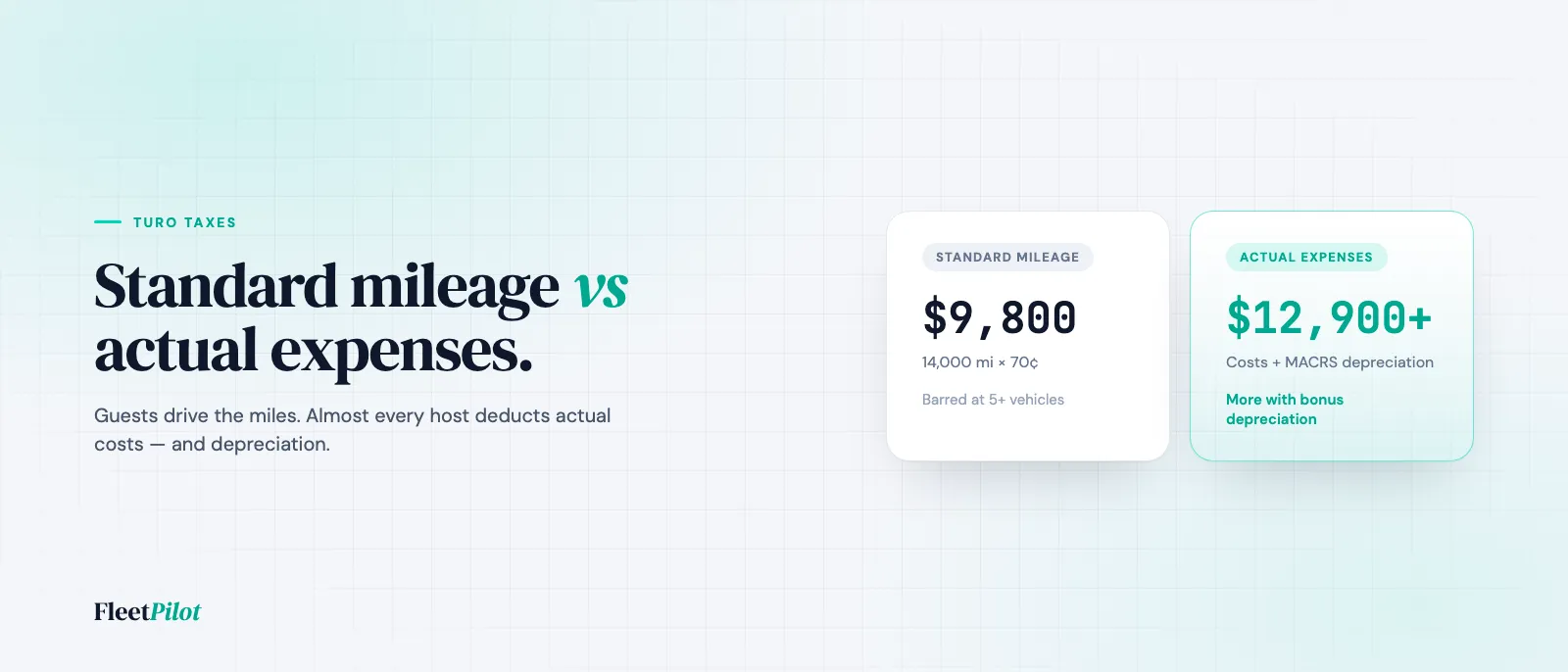
Say a $28,000 vehicle ran 14,000 guest miles in its first year (2025, at the 70¢ rate) and cost $6,400 to insure, maintain, clean and register, with $900 of loan interest.
Standard mileage
Actual expenses
Mileage deduction
14,000 × $0.70 = $9,800
—
Operating costs
included in rate
$6,400
Loan interest
$900 (allowed separately)
$900
Depreciation (year 1, MACRS 5-yr, half-year)
included in rate
~$5,600 — or far more with bonus, subject to luxury-auto caps
Total
≈ $10,700
≈ $12,900+
And that’s before considering bonus depreciation, which can push year-one actual expenses much higher for a qualifying vehicle. Scale to five cars and the gap is the fleet’s entire margin.
How this ties to the rest of your return
The actual expense method is where the Turo tax deductions checklist lives — depreciation is just the largest line on it. It feeds Schedule C, which is why per-vehicle books matter: the IRS wants each vehicle’s depreciation on its own schedule (Form 4562), and you want each vehicle’s true profit for deciding which car to sell next.
FleetPilot tracks costs per VIN from the day a vehicle enters the fleet — receipts, bank transactions, tolls, and claims matched to the right car — and carries the depreciation schedule alongside it, so the “actual expenses” for every vehicle are a report your CPA can file from rather than a shoebox. Start on the Free plan — no credit card required.
Frequently asked questions
Can Turo hosts use the standard mileage rate?
+
In narrow cases — a single vehicle, first year, business use you can substantiate — but it rarely fits. (The rate is 70¢ per mile for 2025; 72.5¢ for January–June 2026 and 76¢ from July 1, 2026.) The rate is designed for a taxpayer's own business driving; Turo miles are driven by guests. Hosts who use five or more vehicles at the same time cannot use it at all. Almost every professional host uses the actual expense method.
What is the actual expense method for a Turo car?
+
You deduct the real, documented costs of the vehicle — depreciation, insurance, maintenance and repairs, tires, registration, loan interest, cleaning, and similar — multiplied by the vehicle's business-use percentage. For a car used only for Turo, that is 100%.
Can I switch from standard mileage to actual expenses later?
+
You can switch from standard mileage to actual in a later year, but you must then use straight-line depreciation for that car for the rest of its life. You generally cannot switch from actual (with accelerated depreciation) back to standard mileage on the same vehicle.
Do guest miles count as my business miles?
+
Guest miles are use of the vehicle in your rental business, which supports the business-use percentage under the actual method. They are not miles you drove for business in the sense the standard mileage rate contemplates, which is a core reason the rate is a poor fit for Turo.
Turo uses "co-host" to mean two completely different things, and conflating them costs owners and operators real money. Here's how the programs differ, what each split actually pays, and what you need in place to run this as a business.
The 1099-K reports gross bookings, not what Turo paid you. Here's who gets one, why the number looks too high, and how to reconcile it so you don't pay tax on Turo's cut.
5 min read·Updated Aug 19, 2026
Co-host statements that are automated and accurate.
FleetPilot turns your Turo, direct rental, and vehicle expense data into a seamless end-of-month owner payout process.