Turo Depreciation Explained: MACRS, Bonus, Section 179, and the Luxury-Auto Caps
How depreciation works for a Turo vehicle: MACRS 5-year recovery, 100% bonus depreciation, Section 179 for heavy SUVs, the Section 280F luxury-auto caps and the leasing exception, basis for cars converted from personal use, and recapture when you sell.
FleetPilot·12 min read·Updated Aug 19, 2026·Reviewed Aug 19, 2026
Key takeaways
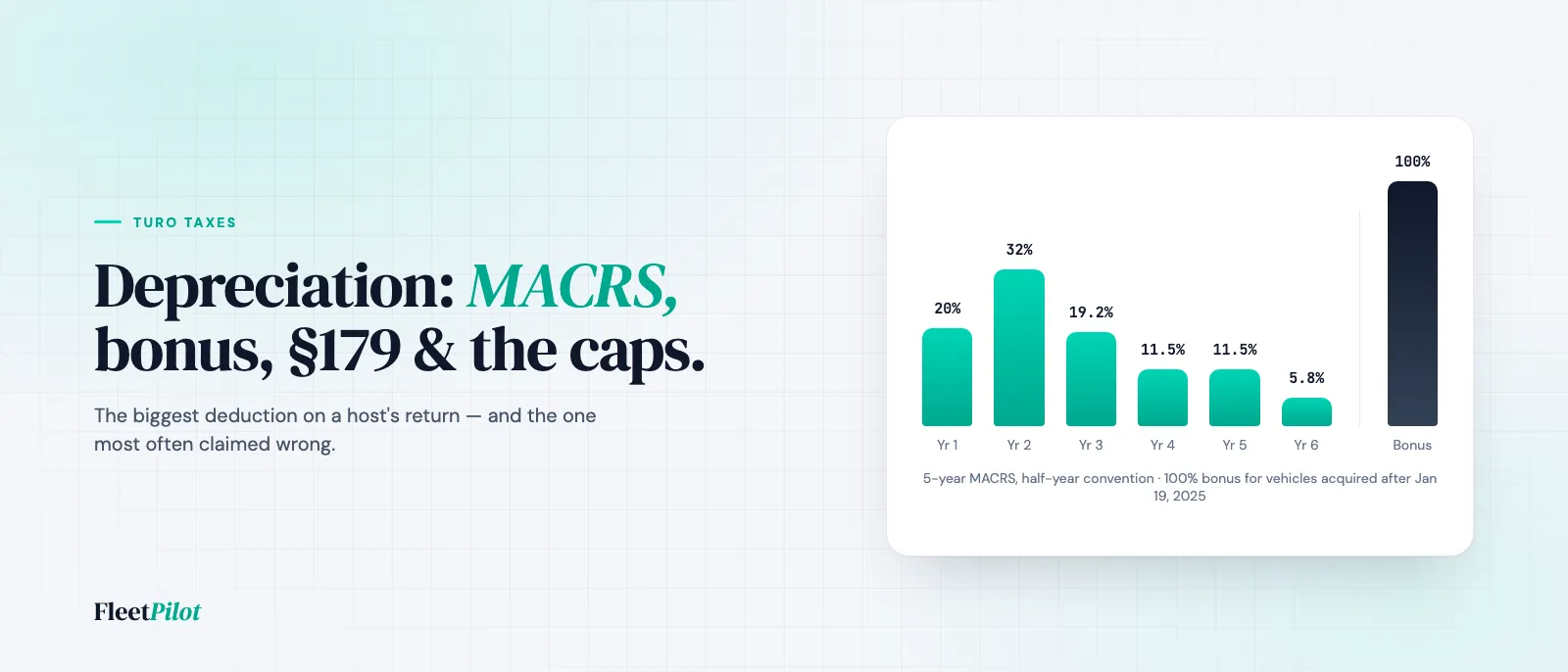
A Turo vehicle is 5-year MACRS property; under the actual expense method its cost basis is deducted over six tax years (20% / 32% / 19.2% / 11.52% / 11.52% / 5.76% with the half-year convention), scaled by business-use percentage.
100% bonus depreciation is available for qualifying vehicles acquired and placed in service after January 19, 2025, and Section 179 lets you expense up to $32,000 (2026; $31,300 for 2025) of a heavy SUV — but both require more than 50% business use.
Passenger automobiles under 6,000 lbs GVWR are capped by Section 280F ($12,300 in year one for 2026, or $20,300 with bonus); the caps don't apply to vehicles over 6,000 lbs, which is why heavy SUVs and trucks are the classic fleet write-off.
Basis for a car converted from personal use is the lesser of your cost or fair market value on the day it enters the business — you cannot depreciate value that already left the car while you drove it personally.
Depreciation is recaptured as ordinary income when you sell for more than adjusted basis; per-vehicle basis and depreciation records are what let you compute — and defend — the number.
Depreciation is where Turo taxes are won or lost. It’s usually the largest single deduction on a host’s Schedule C, it’s the reason a profitable fleet can show a small taxable income in its first years, and it’s the deduction most often claimed wrong — either left on the table or taken in a way that unravels at sale.
You depreciate the vehicle’s basis — usually what you paid, plus sales tax, delivery, and any improvements that add value — over its recovery period, scaled by business-use percentage.
For a car converted from personal use to Turo, basis is the lesser of your original cost or fair market value on the day it entered the business. A $40,000 car you drove for three years and listed when it was worth $24,000 has a $24,000 depreciable basis. The value that left while you drove it personally is gone.
Business-use percentage is business miles over total miles. A dedicated Turo car is 100%; if you also drive it personally, everything below is scaled by that fraction — and if business use ever drops to 50% or below, accelerated depreciation you’ve claimed can be recaptured.
MACRS: the default schedule
Vehicles are 5-year property under MACRS. Using the 200% declining-balance method and the half-year convention — the default — the deduction by year is:
Tax year
% of basis
1
20.00%
2
32.00%
3
19.20%
4
11.52%
5
11.52%
6
5.76%
Six tax years, because the half-year convention assumes the car was placed in service mid-year. If more than 40% of the year’s total asset purchases went into service in the last quarter, the mid-quarter convention applies instead and year-one percentages change — a real issue for hosts who buy several cars in Q4.
Bonus depreciation
Bonus depreciation lets you deduct a large percentage of basis in year one, before the MACRS schedule applies to the rest.
The 2025 federal tax law (OBBBA) restored 100% bonus depreciation permanently for qualifying property acquired and placed in service after January 19, 2025. Property acquired under a binding contract before January 20, 2025 stays on the old phase-down (40% if placed in service in 2025, 20% in 2026).
Bonus applies to new and used vehicles, as long as it’s your first use.
Business use must exceed 50%.
You can elect out by asset class if you’d rather spread deductions across higher-income years.
Bonus is where the passenger-auto caps (next section) bite hardest.
Section 179
Section 179 lets you elect to expense the cost of qualifying property in year one instead of depreciating it. For 2026 the overall limit is $2,560,000 (phasing out above $4,090,000 of purchases; $2,500,000 / $4,000,000 for 2025), so the fleet-wide limit is rarely the constraint. The vehicle-specific limits are:
Passenger automobiles ≤ 6,000 lbs GVWR: Section 179 is folded into the 280F caps below.
SUVs and similar vehicles > 6,000 lbs GVWR: capped at $32,000 of Section 179 for 2026 ($31,300 for 2025) — but the remainder can be taken as bonus depreciation, which is uncapped for these vehicles.
Trucks/vans over 6,000 lbs with a cargo bed or seating configuration that removes them from the “SUV” definition: no Section 179 cap.
Section 179 also can’t exceed your business income for the year (unused amounts carry forward), which is one reason bonus — with no income limit — is usually the tool of choice.
The luxury-auto caps (Section 280F)
Here’s the constraint that surprises hosts. For passenger automobiles — vehicles rated 6,000 lbs GVWR or less — total annual depreciation (MACRS + bonus + 179 combined) is capped. The caps depend on the year the vehicle is placed in service:
Year
Placed in service 2026 (no bonus / with bonus)
Placed in service 2025 (no bonus / with bonus)
1
$12,300 / $20,300
$12,200 / $20,200
2
$19,800
$19,600
3
$11,900
$11,800
4+
$7,160
$7,060
Figures are indexed annually (2026: Rev. Proc. 2026-15). Basis not recovered within the schedule keeps depreciating at the year-4+ amount until it’s gone — a $45,000 sedan takes many years to write off.
Above 6,000 lbs GVWR, none of this applies. That’s the whole reason heavy SUVs, pickups and vans are the fleet write-off of choice: 100% bonus, no cap.
The leasing exception
Section 280F(c) says the caps don’t apply to listed property “leased or held for leasing by any person regularly engaged in the business of leasing such property.” Some practitioners take the position that a host running a real rental fleet qualifies and can depreciate sedans without the caps. It’s a defensible reading with real dollars attached — and a genuine judgment call about facts, scale, and how the business is run. Raise it with your CPA rather than assuming either way.
A worked example
A host places two vehicles in service in March 2025 (the return being filed in 2026), both 100% business use, both acquired after January 19, 2025. For vehicles placed in service in 2026 the sedan cap is $20,300 instead of $20,200 — otherwise identical:
Vehicle A: $32,000 sedan (under 6,000 lbs GVWR)
100% bonus would be $32,000 — but the year-one cap with bonus is $20,200.
The remaining $11,800 follows the MACRS schedule under the caps: 32% × $32,000 = $10,240 in year two (below the $19,600 cap), and the last $1,560 in year three.
Vehicle B: $58,000 heavy SUV (over 6,000 lbs GVWR)
Not a passenger auto under 280F. 100% bonus applies: $58,000 in year one.
(Or elect Section 179 for $31,300 and bonus for the remaining $26,700 — same total.)
Year-one depreciation on $90,000 of vehicles: $78,200. That’s what turns a busy first year into a small taxable profit — and why the estimated-tax rule of thumb in the quarterly taxes guide can overshoot badly.
When you sell: recapture
Depreciation is a timing benefit, not a gift. When you sell a car for more than its adjusted basis (cost minus depreciation claimed), the gain — up to the total depreciation taken — is recaptured as ordinary income under Section 1245.
Vehicle B above sold for $40,000 two years later has an adjusted basis of $0. All $40,000 is ordinary income that year. Not a reason to skip bonus — the deferral is valuable and rates may differ — but a reason to know the number before you list the car, and to time sales into lower-income years when you can.
Deep dive: the Section 179 strategy high earners use — and the passive-loss trap
Section 179 and bonus depreciation are why W-2 earners buy heavy SUVs for Turo in December. The mechanics above are the easy part; the part that decides whether the loss actually offsets your salary is material participation under §469 — and unlike real-estate rentals, vehicle fleets get no $25,000 passive-loss allowance and no help from Real Estate Professional status. The full strategy, the vehicle-weight table, the material-participation tests, and the ways it goes wrong are below.
Read the full Section 179 strategy — weight classes, qualifying vehicles, material participation, and what goes wrong
Disclaimer: This article is for educational and informational purposes only and does not constitute tax, legal, or financial advice. Tax laws are complex, change frequently, and vary by state. Consult a qualified CPA or tax attorney before making any investment or tax planning decisions. Your individual circumstances will determine what strategies are appropriate for you.
A growing number of high-income professionals are purchasing heavy SUVs and commercial vans, listing them on Turo with a professional fleet manager, and claiming substantial first-year depreciation deductions under Section 179. The appeal: deduct the purchase price in year one while generating rental income on a platform with over 160,000 active listings.
But the strategy only works with the right vehicles, the right tax structure, and the right documentation. Get any of those wrong and the tax benefit can be zero. Here is what you actually need to know.
The 7-Day Rule: Why Turo Gets Favorable Tax Treatment
Before getting into vehicle selection, understand the provision that makes this strategy viable: the 7-day rule in the passive-activity regulations (Treas. Reg. §1.469-1T(e)(3)). If the average customer use of your vehicles is 7 days or less, the activity is not a “rental activity” for §469 purposes — so it is not automatically passive. It is passive only if you fail material participation (below).
Turo has publicly described typical trips as a few days long, and most fleets land well under the 7-day average — but the test is your fleet’s average days per rental, computed from your own trips, not a platform-wide figure. The practical effect: you start from a more favorable position than a real-estate investor, because the automatic passive-rental label does not apply. Material participation still decides whether a loss offsets W-2 income.
Why Vehicle Weight Changes Everything
The IRS caps depreciation on passenger vehicles under 6,000 pounds GVWR (Gross Vehicle Weight Rating) at approximately $20,300 in year one (Section 280F limits). Vehicles over 6,000 pounds play by different rules — but there is a critical distinction within that weight class most articles miss:
Weight Class
Section 179 Cap
Bonus Depreciation
Year 1 Max
Under 6,000 lbs
$12,300
+$8,000
~$20,300
6,001–14,000 lbs (SUVs)
$32,000 (2026 SUV cap)
Bonus on remainder
Full purchase price*
6,001–14,000 lbs (Vans/Trucks)
No SUV cap
Bonus on remainder
Full purchase price*
Over 14,000 lbs
No cap
100%
Full purchase price
*Bonus depreciation note: The One Big Beautiful Bill Act (2025) restored 100% bonus depreciation. Always confirm the current bonus rate with your CPA, as this figure is subject to legislative changes. The SUV cap ($32,000 for 2026, inflation-adjusted annually) applies only to the Section 179 portion for SUVs — commercial vans and trucks have no SUV cap, making a Ford Transit or Chevrolet Express significantly more tax-efficient than an SUV at the same purchase price.
Verify GVWR from the Window Sticker
Never rely on online articles or dealer claims for GVWR. The Jeep Wrangler 4-door, for example, is commonly listed as a Section 179 qualifier — but its actual GVWR (~5,500 lbs for most configurations) falls below the 6,000 lb threshold. Conversely, the Kia Carnival (~6,019 lbs on SX/EX trims) is often overlooked but may actually qualify. Always verify from the manufacturer’s spec sheet or the vehicle’s window sticker.
Which Vehicles Qualify — and Perform on Turo?
The ideal vehicle exceeds 6,000 lbs GVWR, generates strong daily rates, and attracts consistent bookings. The illustrative figures below are for one large metro market in 2025 and will differ in yours — run the analysis on your own market before committing capital:
Vehicle
GVWR
Est. purchase
Illustrative daily rate
Demand
Ford Econoline
8,600 lbs
$20–30k
$124/day
Very high
Mercedes-Benz Sprinter
8,550 lbs
$50–65k
$166/day
High
Cadillac Escalade
7,500 lbs
$55–70k
$177/day
High
Ford Transit
9,000+ lbs
$35–55k
$146/day
Moderate
Note that commercial vans (Econoline, Transit, Sprinter) are not subject to the SUV cap on Section 179, giving them a tax advantage over SUVs at similar price points. Your local market may differ — run the analysis for your specific area before committing capital.
The Managed Fleet Model
The strategy is usually paired with a professional Turo host — someone managing 10+ vehicles with All-Star status and a long review history, typically taking 25–30% of gross revenue. You get their established search ranking, full operational management, and higher utilization. Your role: purchasing vehicles, making strategic decisions, and reviewing monthly financials. Be clear-eyed about what that means for material participation: a hands-off owner whose manager does the work will usually fail the tests below. The loss is suspended, not lost — but it will not offset W-2 income that year.
The Catches — Read This Carefully
This strategy is not a cheat code. Misunderstanding any of the following can reduce your tax benefit to zero.
Material participation is non-negotiable. The IRS requires you to pass one of 7 tests under §469(h) for losses to offset W-2 income. The two most relevant for fleet investors:
Test 1 (safest): 500+ hours of documented participation in the activity during the year.
Test 3: 100+ hours AND your hours must exceed those of any other single individual involved in the activity. If your fleet manager logs 110 hours on your fleet and you log 100, you fail this test.
Critical: ballpark reconstructions assembled at tax time routinely lose in Tax Court. A contemporaneous log, kept through the year, is what holds up.
If you fail material participation, the loss is fully suspended. Unlike real estate rentals, vehicle fleets do not benefit from the §469(i) $25,000 passive loss allowance — that provision applies exclusively to rental real property. Without material participation, your vehicle fleet losses are 100% passive and $0 is deductible against W-2 income. The loss carries forward until the fleet generates passive income or you sell the vehicles. For a $200K W-2 earner expecting a $50K tax savings, the actual Year 1 benefit would be zero — deferred indefinitely, not received.
Real Estate Professional status does not help. §469(c)(7) applies only to real property rental activities. It cannot be used to unlock Turo vehicle rental losses, regardless of your RE Professional qualification.
Depreciation recapture is real. When you sell, gain up to the depreciation you claimed is recaptured as ordinary income under Section 1245 — at your marginal rate, not a capital-gains rate. You are deferring taxes to a future year, not eliminating them.
Business use must exceed 50% throughout the vehicle’s depreciable life (typically 5 years). Drop below 50% in any year and you face recapture of previously claimed deductions.
State rules vary. California, for example, has historically limited or decoupled from federal depreciation provisions. Texas has no state income tax, making it one of the most favorable states for this strategy.
You need a specialized CPA. Budget $2,000–4,000/year for a CPA who specializes in vehicle depreciation, rental business structures, and material participation documentation.
Key Takeaways
The 7-day rule (Treas. Reg. §1.469-1T(e)(3)) is the most important provision for Turo operators: with average rentals under 7 days, the fleet is not automatically a passive rental — material participation decides.
The 6,000-pound GVWR threshold is the dividing line between capped and uncapped depreciation. Within the 6,001–14,000 lb range, commercial vans and trucks get better Section 179 treatment than SUVs.
Material participation documentation (500+ hours, or 100+ hours exceeding any other individual) is the make-or-break requirement. Without it, your tax benefit is zero — not reduced, zero. Keep contemporaneous time logs.
The $25K passive loss allowance and Real Estate Professional status do not apply to vehicle fleets. These are real-property-only provisions.
Depreciation recapture applies when you sell. You are deferring taxes, not eliminating them. Some operators time sales into years with new acquisitions so recapture and new depreciation land together — legitimate, but it is deferral, not avoidance, and every year still has to pass material participation.
Always verify GVWR from the manufacturer spec sheet — not from online articles. Common vehicles are routinely misidentified as qualifying or non-qualifying.
Records that make this real
Depreciation lives on Form 4562, per asset. For each vehicle you need: date placed in service, basis (with the conversion FMV if applicable), GVWR class, method and convention chosen, business-use percentage each year, and cumulative depreciation to date. Miss any of it and the deduction is hard to claim and harder to defend — and the recapture calculation at sale becomes a guess.
FleetPilot carries a depreciation schedule for every VIN alongside its P&L — placed-in-service date, basis, method, and accumulated depreciation — so the “true profit” you use to decide when to sell a car already includes the tax consequence, and Form 4562 inputs are a report rather than a reconstruction. Start on the Free plan — no credit card required.
Frequently asked questions
How do you depreciate a car used for Turo?
+
A Turo vehicle is 5-year MACRS property. Using the actual expense method, you deduct its cost basis over six tax years on the 200% declining-balance schedule (20%, 32%, 19.2%, 11.52%, 11.52%, 5.76% under the half-year convention), scaled by business-use percentage. Bonus depreciation and Section 179 can accelerate most or all of it into year one, subject to the passenger-auto limits.
Can I write off the whole car in the first year for Turo?
+
Sometimes. 100% bonus depreciation applies to qualifying vehicles acquired and placed in service after January 19, 2025, but passenger automobiles under 6,000 lbs GVWR are capped in year one — $20,300 for vehicles placed in service in 2026 ($20,200 for 2025). Vehicles over 6,000 lbs GVWR are not subject to that cap and can often be fully expensed via bonus or Section 179, provided business use exceeds 50%.
What are the luxury auto depreciation limits?
+
Section 280F caps annual depreciation on passenger automobiles (under 6,000 lbs GVWR). For vehicles placed in service in 2026 (Rev. Proc. 2026-15): $12,300 in year one ($20,300 if bonus is claimed), $19,800 in year two, $11,900 in year three, and $7,160 each year after until the basis is recovered. The 2025 figures were $12,200 / $20,200 / $19,600 / $11,800 / $7,060. Section 280F(c) exempts property held for leasing by someone regularly engaged in the leasing business — whether a Turo host qualifies is a judgment call to make with a CPA.
What happens to depreciation when I sell a Turo car?
+
Gain up to the amount of depreciation you claimed is recaptured as ordinary income under Section 1245, not capital gain. Selling a car for more than its adjusted basis therefore creates taxable income — plan for it, especially after taking bonus depreciation.
Turo uses "co-host" to mean two completely different things, and conflating them costs owners and operators real money. Here's how the programs differ, what each split actually pays, and what you need in place to run this as a business.
The 1099-K reports gross bookings, not what Turo paid you. Here's who gets one, why the number looks too high, and how to reconcile it so you don't pay tax on Turo's cut.
5 min read·Updated Aug 19, 2026
Co-host statements that are automated and accurate.
FleetPilot turns your Turo, direct rental, and vehicle expense data into a seamless end-of-month owner payout process.