Do You Need an LLC for Turo? Liability, Taxes, and When It Actually Matters
What an LLC does and doesn't do for a Turo host: liability separation, tax treatment (it changes nothing by default), the S-corp election, titling and insurance wrinkles, and the point in fleet growth where forming one becomes obvious.
FleetPilot·4 min read·Updated Aug 19, 2026·Reviewed Aug 19, 2026
Key takeaways
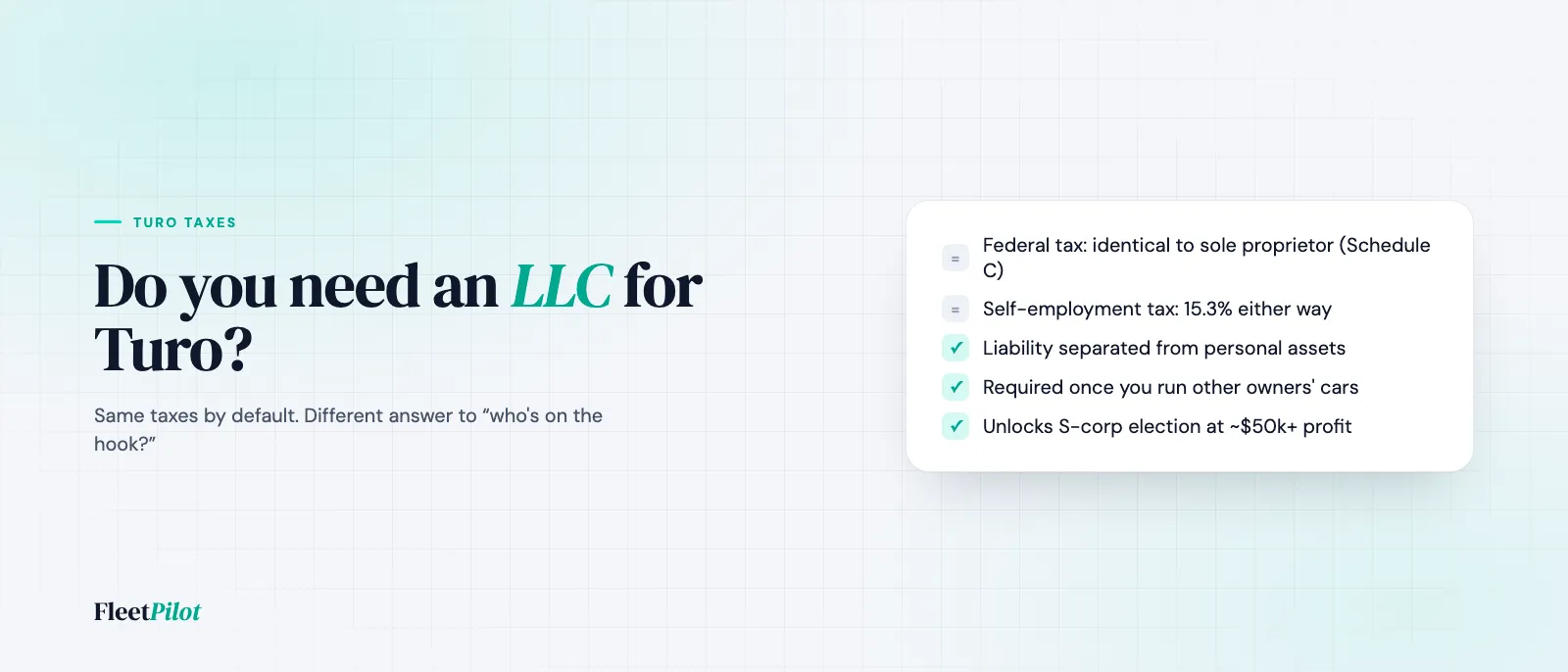
A single-member LLC is disregarded for federal tax purposes: you still file Schedule C and still owe 15.3% self-employment tax, so forming one does not lower your Turo taxes on its own.
What an LLC changes is liability separation and structure — a claim, lawsuit, or debt of the business is far less likely to reach personal assets, provided you actually keep business and personal finances separate.
The moment you operate vehicles for other owners, an LLC (with a co-hosting agreement and separate books) is close to non-negotiable; you are moving other people's money and taking on their risk.
The real tax lever is the S-corp election, which lets a profitable LLC pay part of its earnings as distributions not subject to self-employment tax — worth evaluating once net profit is roughly $50,000+.
Whatever the entity, keep a dedicated bank account, per-vehicle books, and owner statements; commingling is what dissolves the liability shield in practice.
“Should I set up an LLC?” is the second question every new Turo host asks, right after “how much can I make?” The honest answer has two halves that people usually hear as one:
For taxes: an LLC changes almost nothing.
For risk and structure: it changes a lot — and past a certain size it’s not optional.
What an LLC is (and isn’t)
An LLC is a state-law entity. It exists to separate the business’s obligations from its owners’ personal assets. It is not a tax status. The IRS lets you pick how an LLC is taxed:
Single-member LLC: disregarded by default — you file Schedule C on your personal return, exactly as if there were no LLC.
Multi-member LLC: taxed as a partnership by default (Form 1065, K-1s to each member).
Either can elect S-corp treatment (Form 2553), which is where actual tax savings can appear.
So a host who forms an LLC and does nothing else has the same tax bill as before, plus a state filing fee.
The tax picture, with or without an LLC
For almost every host, Turo income is active business income: you clean, deliver, message guests, handle claims, and maintain vehicles. That makes it Schedule C, not passive Schedule E rental income — and it’s subject to self-employment tax of 15.3% (Social Security and Medicare) on net profit, on top of income tax.
An LLC doesn’t change that. What changes it is the S-corp election:
The S-corp pays you a reasonable salary (subject to payroll tax) and the rest of the profit as distributions (not subject to SE tax).
That saves roughly 15.3% on the distribution portion (2.9% once salary clears the Social Security wage base) — partly offset by payroll cost, a separate return (Form 1120-S), and a smaller QBI deduction.
Rule of thumb: worth modeling once net profit reliably clears about $50,000. Below that, the overhead eats the savings.
If a guest is injured, a third party sues over an accident, or a vendor goes unpaid, an LLC means a claim against the business generally stops at the business’s assets — it does not shield you from your own negligence, and it only holds if you’ve maintained the separation. That means a dedicated bank account, contracts signed by the LLC, and no personal spending from the business account. Courts set the shield aside when an LLC is run like a personal account.
Two honest caveats: Turo’s host protection plans and any commercial policy are your first line of defense regardless of entity, and personal guarantees on auto loans put you on the hook for that debt either way.
Credibility and structure
Owners, lenders, insurers and vendors take “Summit Auto Fleet LLC” more seriously than a personal Venmo. A lender-ready P&L (see lender packets) is far easier to produce from an entity with its own books.
A container for other people’s cars
This is the tipping point. The moment you operate vehicles for outside owners — co-hosting — you’re taking their asset risk, moving their money, and issuing owner statements. Doing that as an individual with commingled accounts is how partnerships blow up. An LLC plus a co-hosting agreement plus separate per-vehicle books is the minimum professional setup.
Costs and friction
State fees: formation is $50–$500 depending on state; annual fees range from nothing to California’s $800 minimum franchise tax.
Vehicle titling: titling cars in the LLC is the cleanest liability separation but often violates a personal auto loan’s terms and requires commercial insurance. Many hosts leave titles personal and lease the vehicles to the LLC under a written lease with real payments, or buy future vehicles directly in the LLC’s name. Get an attorney’s read for your state.
Insurance: commercial policies cost more, and some carriers won’t write personal coverage on a car listed on Turo anyway.
Bookkeeping discipline: the LLC only protects you if the books are separate. That’s a feature, not a bug — it’s the same discipline that makes taxes and owner statements painless.
When to form one: a practical ladder
Where you are
Recommendation
1–2 of your own cars, testing
Optional. Get a separate bank account regardless.
3–5 of your own cars, real revenue
Form a single-member LLC. Cheap insurance against a bad day.
Any cars owned by other people
Form the LLC before you take the first owner’s car. Sign agreements as the LLC.
Net profit reliably $50k+
Model the S-corp election with your CPA.
Multiple partners in the business
Multi-member LLC (or LLC electing S-corp) with an operating agreement that spells out splits and exits.
The part that matters more than the entity
Whether or not you file the paperwork, the habits an LLC forces are the ones that protect you: one bank account for the business, every vehicle’s costs tracked to that vehicle, owner money accounted for separately from yours, and statements that tie to deposits.
FleetPilot is built around that structure — a dedicated ledger for the fleet, per-VIN P&L, and owner statements and payouts kept distinct from your operating funds — so the separation is real in the books, not just on the formation certificate. Start on the Free plan — no credit card required.
No. Turo lets individuals host, and a single-member LLC is taxed exactly like a sole proprietor by default. An LLC is about separating business liabilities from personal assets and about structure — it becomes worth its cost as the fleet grows, and close to essential once you operate vehicles for other owners.
Does an LLC lower my Turo taxes?
+
Not by itself. A single-member LLC is disregarded for federal tax purposes and files Schedule C, the same as no LLC. Tax savings come from elections and deductions — most notably an S-corp election once profit is high enough to justify running payroll — not from the LLC wrapper.
Is Turo income Schedule C or Schedule E?
+
For nearly all hosts, Schedule C. Turo hosting involves substantial services — cleaning, delivery, guest communication, maintenance — which makes it an active trade or business subject to self-employment tax, not passive rental income on Schedule E. Confirm your facts with a CPA.
Should I title my Turo cars in the LLC?
+
Titling in the LLC strengthens liability separation but can affect your auto loan (many personal loans prohibit transfer), your insurance (commercial policies cost more), and registration. Many hosts keep vehicles personally titled and lease them to the LLC under a written lease, or buy new vehicles directly in the LLC. Discuss with an attorney and your lender before moving titles.
Turo uses "co-host" to mean two completely different things, and conflating them costs owners and operators real money. Here's how the programs differ, what each split actually pays, and what you need in place to run this as a business.
The 1099-K reports gross bookings, not what Turo paid you. Here's who gets one, why the number looks too high, and how to reconcile it so you don't pay tax on Turo's cut.
5 min read·Updated Aug 19, 2026
Co-host statements that are automated and accurate.
FleetPilot turns your Turo, direct rental, and vehicle expense data into a seamless end-of-month owner payout process.