Key takeaways
- Scaling from five cars to fifty is a structural change, not a bigger to-do list: sourcing, maintenance, cleaning, communication and parking each move from personal effort to a system with someone else running it.
- Standardizing on a few reliable models is the single biggest operational lever — it enables bulk consumables, repeatable maintenance, and simpler pricing.
- Six maintenance intervals, tracked per vehicle by actual guest miles rather than by calendar, prevent most of the breakdowns and claims that erase fleet margins.
- Turo's 2026 earnings plans trade host share for protection; match each vehicle to its own plan by repair cost and claim risk instead of blanketing the fleet.
- Compliance is per-vehicle work — inspections, mileage re-certification, business-status disclosure where required — and past ten cars it has to be tracked automatically.
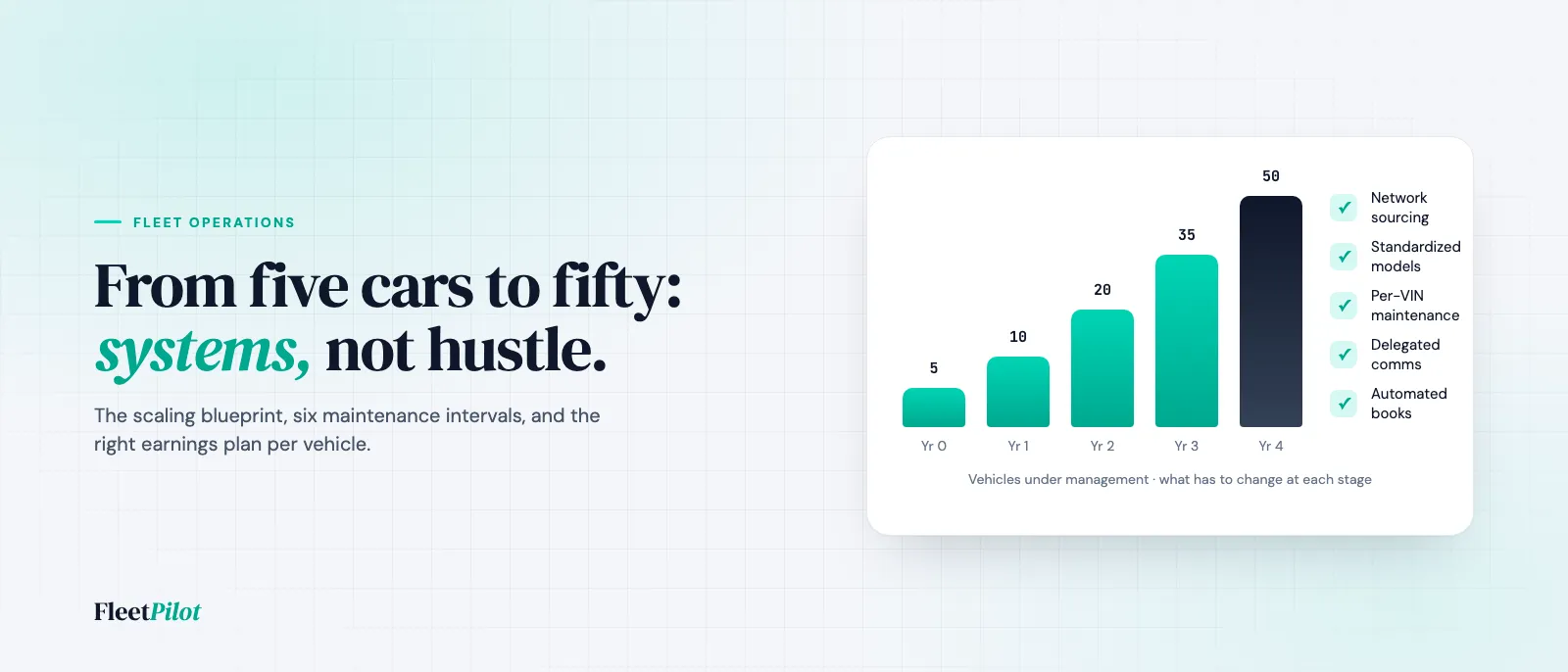
Scaling a Turo fleet isn’t a linear progression. Two cars become five with more hustle; five never become fifty that way. Somewhere around ten vehicles, every part of the operation — sourcing, maintenance, cleaning, guest communication, parking, and the books — has to stop depending on the owner’s personal time and start running as a system.
This guide collects the three operating playbooks behind that transition. Each is written to be read on its own; expand the one you need.
The scaling blueprint: systems over hustle
The jump to high volume increases depreciation and repair frequency faster than revenue. The fleets that make it are built on three foundations — volume-driven procurement, automated workflows, and team-based delegation — and the table inside shows what each function looks like at small scale versus professional scale.
Read the full scaling blueprint — procurement, workflows, delegation
Scaling a Turo fleet from a handful of personal vehicles to a 50-car operation isn’t a linear progression — it’s a structural evolution. As industry veterans emphasize, car sharing isn’t a get-rich-quick scheme, and the jump to high volume increases depreciation and repair frequency exponentially. The 2026 scaling blueprint is built on three foundations: volume-driven procurement, automated workflows, and team-based delegation.
The Volume Bottleneck — Procurement and Maintenance
At small scale, you can source and recondition vehicles one by one. At 50 cars, sourcing must be network-driven — buying from institutions and dealerships that provide fleet-condition vehicles at scale, not one-off marketplace deals.
Maintenance requires a “brand strategy.” Managing 10 different makes and models creates admin chaos. The professional standard: standardize on a few reliable models (Toyota SUVs, Hyundai sedans) to enable bulk purchasing of consumables. Standardizing models lets you buy filters, wipers and fluids in bulk, which is meaningfully cheaper than retail one-offs.
| Component | Small Scale (1-5 Cars) | Professional Scale (20-50+) |
|---|
| Sourcing | Individual/Private Party | Institutional/Network-driven |
| Maintenance | Outsourced to Local Shops | In-house/Contracted Techs |
| Cleaning | Driveway/Personal Time | Commercial Hub/Bulk Inventory |
| Communication | Direct Messaging | Virtual Assistants/Open Phone |
| Parking | Street/Personal Driveway | Commercial Warehouses |
Automate the Turnover Lifecycle
Manual tasks you’ve gotten good at are the hardest to hand off — and the first ones to automate. Scaling requires automating the entire turnover lifecycle: reservation confirmation through checkout validation.
The “Checkout Assistant” approach is a cornerstone for 2026. By automatically retrieving reservations and monitoring trip status in real-time, software generates post-trip alerts for proactive action. If a guest returns a car with excess mileage or low fuel, the system detects it via telematics and presents evidence immediately — instead of after the guest is gone.
Building a Host Team — Delegation Over Heroics
The professional fleet operator focuses on “intentional design” rather than being the fastest responder. This requires tools for team delegation: shared communication platforms, central dashboards for service claims and cleaning status, and designated work phones at each turnover hub.
This systematic approach is how operators run 30–40 cars without personally touching every turnover — spending their time on strategy rather than airport deliveries.
Financial Discipline — Total Cost of Ownership
Running older vehicles isn’t the problem; running them without disciplined maintenance is. Cost per mile climbs with age — when a vehicle’s maintenance cost per mile crosses roughly $0.08 and stays there, plan the exit.
Professional fleets make replacement decisions based on data, not breakdowns. They track true Total Cost of Ownership — not just acquisition price. The most successful hosts “cash out” of an asset at peak utility rather than riding it to mechanical failure.
The maintenance playbook: six intervals that pay for themselves
Maintenance is where fleet margins quietly die: a missed brake check becomes a claim, a neglected battery becomes a stranded guest and a one-star review. The six intervals below cover most of that risk, and the key is tracking each one per vehicle, by actual guest miles — not by calendar.
Read the full maintenance playbook — the six intervals and how to track them
Why rental maintenance is its own discipline
Every dollar you spend on preventative maintenance is a dollar you don’t spend on a tow truck, a lost weekend of bookings, or a 2-star review that mentions the “weird grinding noise.” A vehicle off the road for three days during summer peak season can lose $400–$600, depending on your market, in trip revenue, plus whatever the actual repair costs. The job isn’t to minimize maintenance spend — it’s to maximize uptime per dollar.
That’s the lens for every interval below. None of these are aspirational. They’re the floor.
1. Oil changes — synthetic, every 5,000 miles
Skip the 3,000-mile myth and skip the 10,000-mile interval the dealer claims is fine. For a vehicle running rental miles, full synthetic every 5,000 miles is the sweet spot. It costs maybe $20–$30 more per change than conventional and buys you significant engine longevity on a car you plan to run to 150K+.
Log the odometer reading every time. Not the date — the odometer. Date-based intervals fall apart the moment a car has a slow month, and that’s exactly when guests notice an underserved car.
A windshield sticker isn’t a system — the next guest peels it off. The log is the system.
2. Tires — rotate every 7,500, replace at 4/32″
Rotate every 7,500 miles. All-season tires are almost always the right call for a rental fleet — they’re cheaper than performance tires, they last longer, and you’re not the one trying to lap Laguna Seca on the weekend.
The replacement rule is the one most new hosts get wrong: replace at 4/32″, not 2/32″. 2/32″ is the legal minimum. 4/32″ is where wet-weather stopping distance starts to fall off a cliff. A hydroplaning incident on a renter-driven car is the worst kind of claim you can have — insurance gets involved, the guest gets hurt, and the car is down for weeks. Replacing tires 2/32″ early is cheap insurance.
Buy in sets of four when you can, or at minimum in matched pairs on the same axle. Mismatched tread depths front-to-back change how a car handles, and a renter who feels something “off” leaves a review about it.
3. Brakes — pad inspection every 15,000 miles
Rental driving is harder on brakes than personal driving. Renters brake later, brake harder, and don’t engine-brake on descents. Inspect pads every 15,000 miles and assume you’re replacing earlier than the spec sheet says.
Always replace rotors with pads if the rotors are anywhere near minimum thickness. Turning rotors to save $60 feels smart until you get pulsing brakes 8,000 miles later and you’re back at the shop. On a rental fleet, the time cost of being at the shop twice is more expensive than the parts cost of doing it once.
4. Fluids — the maintenance nobody does until it’s too late
Coolant, transmission fluid, brake fluid, power steering fluid — this is where new hosts get bit. Engines and transmissions don’t fail because someone skipped an oil change. They fail because nobody ever flushed the coolant or the trans fluid and a $40 service became a $4,500 transmission rebuild.
- Coolant flush every 30,000 miles. Especially in hot climates. A blown head gasket on a rental car is a vehicle-killer.
- Transmission fluid every 40,000 miles. Most automatics. Some CVTs have different intervals — check the spec for your specific vehicle.
- Brake fluid every 2 years or 30,000 miles. Brake fluid absorbs moisture. Old brake fluid is the reason a brake pedal goes soft.
Put these on the calendar by mileage the moment a car joins the fleet. They’re easy to forget because nothing visibly tells you they’re due.
5. Filters — cheap insurance the renter actually notices
Cabin air filter and engine air filter, both every 15,000 miles. Total parts cost: $30–$50. Labor on a cabin filter is usually 5 minutes if you do it yourself.
The cabin filter is the one that matters for reviews. A musty-smelling AC vent shows up in trip ratings as “the car smelled.” The renter doesn’t know it’s a $15 part — they just know it was unpleasant. The engine filter affects fuel economy and engine wear; the renter never sees it, but you do when you’re paying for the gas your renter didn’t refill.
6. Cost per mile — the rule that tells you when to retire
This is the most important number in your fleet and the one new hosts almost never track. Take total lifetime maintenance spend on a vehicle, divide by lifetime miles. That’s your cost per mile.
For a healthy rental vehicle in years 1–3, you should see $0.03–$0.06 per mile in maintenance. By years 4–5, it creeps up. When it crosses $0.08/mile and stays there, the car is telling you it’s done. Major repairs are coming. The math on keeping it past that point almost never works once you factor in lost-uptime days.
Intervals and costs below are typical for mainstream sedans and SUVs; follow the manufacturer schedule for your specific vehicle.
| Service | Interval | Typical cost |
|---|
| Oil change (synthetic) | 5,000 mi | $70–$110 |
| Tire rotation | 7,500 mi | $25–$50 |
| Brake pad inspection | 15,000 mi | Free w/ rotation |
| Air + cabin filter | 15,000 mi | $30–$80 |
| Coolant flush | 30,000 mi | $120–$180 |
| Trans fluid service | 40,000 mi | $180–$300 |
| Tire set (4) | 30,000–45,000 mi | $600–$1,000 |
| Brake pads + rotors | 40,000–60,000 mi | $400–$700 |
Build a per-vehicle maintenance log from day one. Date, odometer, service, cost, vendor, link to the receipt. Without this log, you can’t calculate cost per mile, you can’t defend tax deductions, and you can’t tell a co-host owner when their car is past its prime.
The bigger lesson: maintenance is a data problem
Every section above ends in the same place — track it. The intervals don’t actually help anyone whose system is “I’ll remember.” The first vehicle is manageable in your head. The third one isn’t. By the fifth, hosts who haven’t built a real log are missing services, double-paying for repairs, and watching margins quietly bleed out.
The hosts who scale past 5 cars all converge on the same setup: every receipt linked to a vehicle, every service logged against an odometer reading, every dollar showing up on the right car’s P&L. The hosts who don’t either plateau or burn out chasing paperwork on a weekend.
You don’t need anything fancy on day one. A spreadsheet works. What matters is that the system exists before you need it — because by the time you need it, you’re already losing money to the gaps.
Earnings plans: match the plan to the vehicle
In 2026 Turo restructured its host plans into three tiers, each trading host share for protection. The mistake is putting the whole fleet on one plan: economy workhorses usually belong on the highest-share plan, luxury and high-performance cars on the most protective one, most SUVs in between. Duration discounts and tightening state rules also changed how fleets list.
Read the full 2026 earnings-plan guide — plan tiers, duration strategy, compliance
In 2026 Turo restructured its host plans into three tiers that trade host share for protection. For a fleet, plan selection became a per-vehicle decision, not a one-time setting.
The three plan tiers
Each plan gives you a different host share — the percentage of each booking you keep — in exchange for a different level of protection. The current percentages are in your Turo host dashboard; they have changed more than once, so check there rather than relying on a number in an article. The shape of the decision is stable:
- Highest-share plan: the usual choice for economy workhorses — high-reliability, low-repair-cost vehicles — where the cost of a worst-case claim is manageable and you’re comfortable carrying more of the risk.
- Middle plan: the common fit for mid-tier SUVs and family vehicles with moderate repair costs — meaningful protection without giving up much per trip.
- Most-protective plan: the usual choice for luxury and high-performance vehicles, where a single incident can mean a total-loss declaration and a repair bill that starts at four figures.
One plan for the whole fleet usually overpays for protection on some cars and under-protects others. Match each vehicle to the plan that maximizes its own contribution — repair history, vehicle value, age and trip pattern are the inputs.
Duration and advance-booking discounts
Turo has leaned into advance-booking and duration discounts; use them deliberately rather than accepting defaults. Advance bookings tend to attract guests with confirmed plans rather than last-minute renters, and longer trips mean fewer turnovers per dollar. Many fleet operators set baseline discounts across several trip lengths — a modest one for multi-day trips, a stronger one for weekly rentals, and aggressive monthly pricing that fills calendar gaps.
Listings that actually get booked tend to get more visibility, so price for utilization rather than for the occasional high-rate trip.
Compliance is per-vehicle work
Several states have tightened peer-to-peer car-sharing rules — age-based inspections, mileage-based re-certification, and business-status disclosure for some hosts — and platforms enforce listing requirements more actively than they used to. Requirements vary by state and change; check your state’s statute and Turo’s current listing requirements, and track inspection dates and mileage thresholds per vehicle. For a host with two or three cars a spreadsheet works. Past ten, it needs to be automated.
What this means for your fleet
Match each vehicle to the right plan using its own data — repair history, vehicle age and value, market segment, trip patterns. A blanket highest-share plan across a mixed fleet can look good until one luxury-vehicle claim erases a quarter’s profit; a blanket most-protective plan wastes share on reliable economy cars with clean claim histories. At scale, a few points of host share on a high-utilization vehicle adds up to real money every month — so it’s worth the per-vehicle decision.
What ties the three together
Every one of these playbooks generates data per vehicle — purchase price, maintenance events, plan take rate, utilization, claims — and the fleets that scale are the ones where that data lands in one place. That’s what makes per-vehicle profit real, keeps owner statements accurate when you’re managing other people’s cars, and turns tax time into a report instead of a reconstruction.
FleetPilot is built for that stage: trips from Turo and direct channels, maintenance and receipts, tolls, claims and bank activity matched to each VIN, with per-vehicle P&L, owner statements and tax-ready reporting from the same ledger. Start on the Free plan — no credit card required.
Frequently asked questions
What changes when a Turo fleet grows past 10 vehicles?
+
Three things stop scaling: one-by-one sourcing, personal-time maintenance and cleaning, and the owner answering every guest message. Past ten cars the fleets that keep growing move to network-driven procurement, standardized models with bulk consumables, a commercial hub for cleaning and parking, and delegated guest communication — with the financials automated so month-end doesn't scale with the car count.
What maintenance schedule should a Turo host follow?
+
Six intervals cover most of the risk: oil and filter on a mileage cadence tied to actual guest miles, tire rotation and tread checks, brake inspection, battery and charging checks, wiper and fluid top-offs at every turnover, and scheduled manufacturer services. Tracking them per vehicle — not per calendar — is what keeps a 20-car fleet off the side of the road.
Which Turo earnings plan should a fleet use?
+
Not one plan for the whole fleet. Economy, high-reliability vehicles usually belong on the highest take-rate plan; mid-tier SUVs on the balanced plan; luxury and high-performance vehicles on the most protective plan, where a single claim could erase months of earnings. Match the plan to each vehicle's repair cost and claim risk, and revisit as the fleet changes.
Do older Turo vehicles need inspections?
+
In several states, yes. Rules vary and have been tightening — age-based inspection certificates, re-certification at mileage thresholds, and business-status disclosure for some hosts — and platforms enforce listing requirements. Check your state's current rules and Turo's listing requirements, and track inspection dates and mileage per vehicle so nothing gets deactivated.